









 Shop all Blood Pressure
.png?v=1776367209871)
.png?v=1776367221691)
.png?v=1776367235172)
AUTHOR
Dr. Cheryl Burdette
Educational Contributor, Humann
Introduction
Cholesterol health is often reduced to a single number on a lab report—but the reality is far more complex. Healthy cholesterol balance depends on the dynamic relationship between LDL and HDL levels, triglyceride metabolism, and the integrity of the endothelium (the inner lining of blood vessels) that lines every artery and vein in the body. When these systems are working well, the liver produces and clears cholesterol efficiently, lipids are transported and metabolized properly, and the vessel wall remains healthy and resilient.
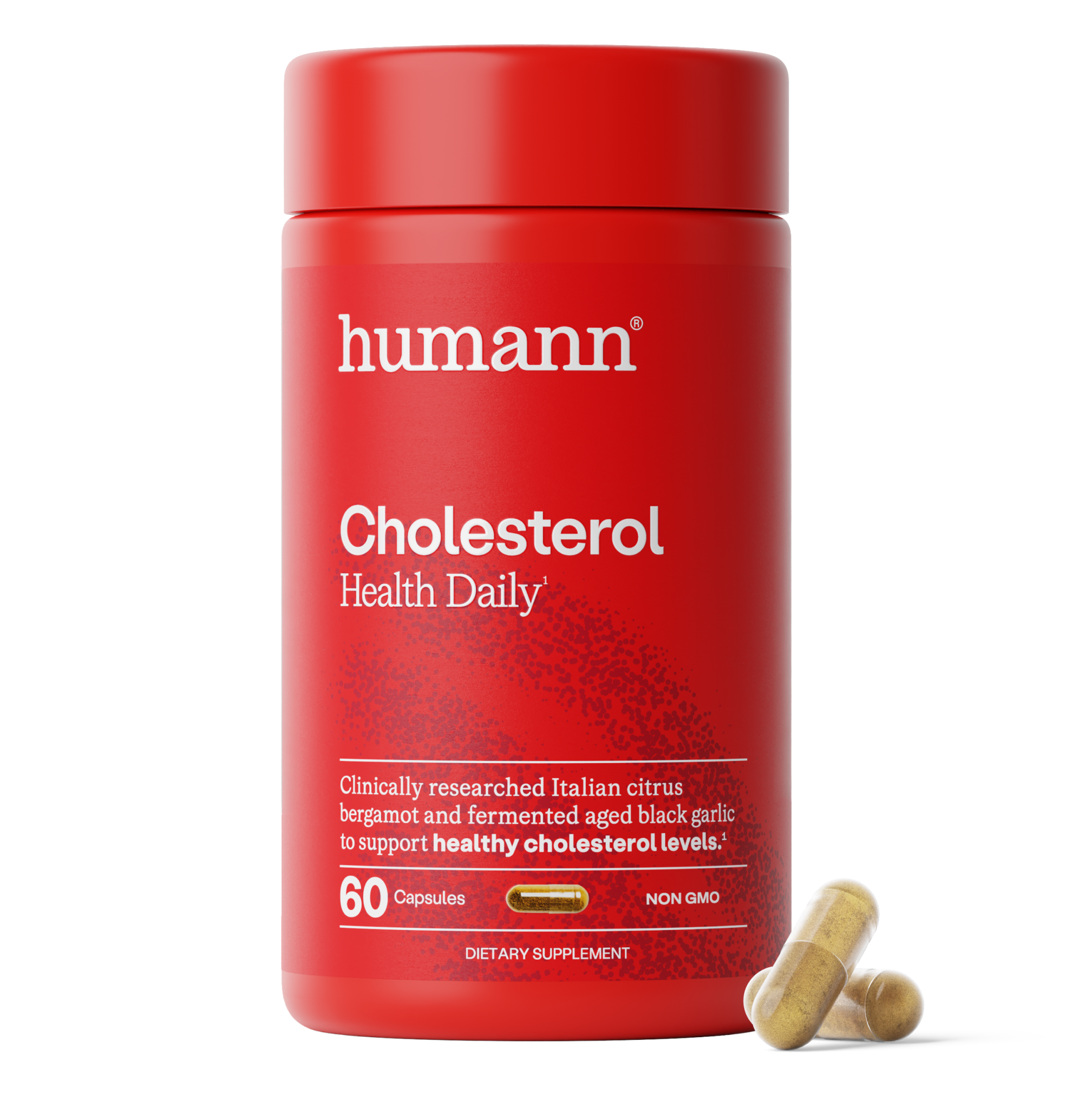
Natural compounds found in botanicals and foods have long played a role in supporting these interconnected systems. Patented citrus bergamot extract, rich in flavonoids, and high-potency aged black garlic extract, rich in S-Allyl-Cysteine (SAC), represent two well-researched examples of how targeted nutrition can influence cholesterol metabolism through multiple, complementary pathways. Together, they address not just a single cholesterol marker, but a broader range of lipid health factors that contribute to long-term cardiovascular wellness.
Citrus Bergamot: Flavonoid-Rich Support for Healthy Cholesterol
What Is Citrus Bergamot?
Bergamot is a bright yellow citrus fruit probably most familiar to the Western world as the botanical that gives Earl Grey Tea its distinctive flavor. Beyond its culinary use, bergamot is loaded with biologically active compounds called polyphenols and flavonoids—plant-based molecules that interact directly with the body’s cholesterol-regulating pathways. When looking for the highest quality form of this ingredient, patented extracts that are standardized and analyzed for the highest levels of these active flavonoids offer the most reliable and research-backed support.¹
Bergamot’s flavonoids support healthy cholesterol across multiple markers. Its actions help to naturally support total cholesterol levels while also improving HDL—the “good” cholesterol—which many clinicians consider equally as important as lowering LDL. HDL cholesterol functions as an antioxidant in the body and plays a key role in reverse cholesterol transport, helping bring excess cholesterol back to the liver where it can be properly processed and removed. Bergamot also supports healthy triglyceride levels and may help decrease the fats produced by the liver.
How Bergamot Works: Key Mechanisms of Action
The different flavonoids in bergamot have distinct mechanisms of action, allowing for support across multiple aspects of cholesterol metabolism. One key mechanism is the inhibition of HMG-CoA reductase—the same enzyme targeted by statin medications—which plays a central role in regulating cholesterol production in the liver. By modulating this pathway, bergamot’s flavonoids may help the body produce less LDL cholesterol while supporting a healthier overall lipid profile.
Bergamot also supports healthy endothelial function—the health and integrity of the blood vessel lining—which is directly influenced by cholesterol balance. Excess LDL cholesterol can negatively affect the endothelium over time, and bergamot’s antioxidant flavonoids may help support the vessel wall as part of a broader cholesterol health strategy.
What the Research Shows
In a study examining patients who were statin intolerant, bergamot was used as an alternative approach to support healthy cholesterol. After 30 days of taking bergamot, serum total cholesterol and LDL cholesterol were reduced, while HDL increased and triglycerides improved—demonstrating meaningful support across multiple lipid markers simultaneously.²
A separate six-month prospective study in subjects with moderately elevated cholesterol found that bergamot extract produced meaningful reductions in total cholesterol, LDL, and triglycerides, along with increases in HDL. Notably, the study found that bergamot specifically targeted small, dense LDL particles—the most atherogenic form of LDL—suggesting its benefits extend beyond standard lipid panel numbers to the quality and composition of cholesterol in the bloodstream.³
High-Potency Aged Black Garlic Extract and SAC: Clinically Studied Cholesterol Support
What Is Aged Black Garlic Extract?
Garlic has thousands of studies supporting its role in overall health, but one of the practical challenges of raw garlic is stability—its active compounds can oxidize and degrade over time, reducing their effectiveness. The aging process transforms garlic into a more stable, odor-reduced form by converting allicin, the primary active compound in fresh garlic, into new sulfur-containing compounds that are both better tolerated and more bioavailable.⁴
The most studied of these aging-derived compounds is S-Allyl-L-Cysteine, or SAC—a potent sulfur-containing molecule found in high concentrations in aged black garlic extract. Compared to intact or fresh garlic, SAC has fewer odors and increased stability, which allow for consistent health benefits without the unpleasant side effects associated with raw garlic consumption.⁴
Key Mechanisms and Clinical Research Findings
SAC and the broader array of bioactive compounds in aged black garlic extract work through multiple pathways to support healthy cholesterol and lipid metabolism. Research suggests these compounds support the liver’s ability to process and clear lipids, help reduce oxidative stress within the vascular system, and may support healthy inflammatory balance—all of which are relevant to long-term cholesterol and cardiovascular health.⁵
The most direct clinical evidence comes from a 2023 randomized, double-blind, placebo-controlled study of 56 healthy adults who took high-potency aged garlic extract daily for 12 weeks. The results demonstrated meaningful improvements across multiple cholesterol markers simultaneously:⁶
Clinical Results: High-Potency Aged Black Garlic Extract (12-Week RCT, n=56)
• HDL (“good” cholesterol) improved by up to 11.5%⁶
• Total cholesterol supported by nearly 12%⁶
• Supports healthy triglycerides up to 12%⁶
• No serious adverse events reported
Source: Nirvanashetty S. Journal of Complementary and Alternative Medicine. 2023;6(1).
These results are particularly notable because they reflect improvements across HDL, total cholesterol, and triglycerides in a single intervention—addressing the full lipid profile rather than a single marker. Participants continued their normal routines throughout the study, suggesting that these results reflect the effect of the aged black garlic extract alongside everyday lifestyle habits.
How These Two Ingredients Work Together
Patented citrus bergamot extract and high-potency aged black garlic extract each address healthy cholesterol through distinct but complementary pathways. Bergamot primarily works through its flavonoids to influence cholesterol production in the liver (via HMG-CoA reductase), support HDL function, and promote healthy endothelial integrity. Aged black garlic extract, through SAC and related sulfur compounds, supports the liver’s lipid processing, reduces oxidative stress relevant to cholesterol metabolism, and has demonstrated direct improvements across the full lipid panel in clinical research.
Together, these ingredients offer a multi-pathway approach to cholesterol support that goes beyond what either compound delivers alone. Rather than targeting a single mechanism, they address lipid production, lipid clearance, HDL function, triglyceride levels, and vascular health in a coordinated way—making them a compelling combination for comprehensive cholesterol health support.
Key Takeaways
Summary: What the Science Tells Us
-
Healthy cholesterol goes beyond a single number—it reflects the balance of HDL, LDL, triglycerides, and the lipid-processing capacity of the liver and endothelium.
-
Patented citrus bergamot extract, rich in flavonoids, supports healthy cholesterol by inhibiting HMG-CoA reductase, improving HDL, reducing LDL and triglycerides, and targeting small dense LDL particles.
-
High-potency aged black garlic extract, rich in SAC (S-Allyl-Cysteine), has been shown in a 12-week randomized controlled trial to improve HDL by up to 11.5%, support healthy total cholesterol levels by nearly 12%, and reduce triglycerides by up to 12%.
-
Both ingredients work through multiple, distinct pathways to address the full lipid profile—making them a complementary combination for comprehensive cholesterol health support.
-
When used alongside a healthy diet, regular movement, and stress management, these natural compounds offer meaningful support for maintaining healthy cholesterol levels long-term.
-
Consult your healthcare provider before starting any new supplement regimen, especially if you are currently taking cardiovascular medications.
Conclusion
Cholesterol health is best supported when we move beyond a narrow focus on a single number and instead consider the full picture—how cholesterol is produced, transported, cleared, and how the vessel wall responds to lipid balance over time. Patented citrus bergamot extract and high-potency aged black garlic extract provide a compelling example of how targeted plant-based compounds can support multiple aspects of cholesterol and lipid health simultaneously.
Through mechanisms that influence cholesterol production, HDL function, triglyceride metabolism, and endothelial support, these clinically studied ingredients may help create the conditions for a healthier lipid profile. When used as part of a comprehensive lifestyle approach—including a healthy diet, regular movement, and stress management—these natural compounds offer meaningful support for maintaining healthy cholesterol levels and promoting long-term vascular wellness.
Important Notice
This information is for educational purposes only and is not intended as medical advice, diagnosis, or treatment. The content presented here should not replace consultation with a qualified healthcare provider. Always consult your physician or other qualified health professional before starting any new supplement regimen, especially if you have existing cardiovascular conditions or are taking medications. Individual results may vary, and supplements are intended to support, not replace, a healthy lifestyle including proper diet and exercise.
References
1. Janda E, et al. Molecular mechanisms of lipid- and glucose-lowering activities of bergamot flavonoids. PharmaNutrition. 2016 Oct;4(suppl):S8–S18. doi:10.1016/j.phanu.2016.05.001.
2. Mollace V, et al. Hypolipemic and hypoglycaemic activity of bergamot polyphenols: from animal models to human studies. Fitoterapia. 2011 Apr;82(3):309–316. doi:10.1016/j.fitote.2010.10.014.
3. Toth PP, Patti AM, Nikolic D, et al. Bergamot Reduces Plasma Lipids, Atherogenic Small Dense LDL, and Subclinical Atherosclerosis in Subjects with Moderate Hypercholesterolemia: A 6 Months Prospective Study. Frontiers in Pharmacology. 2016;6:299.
4. Journal of Functional Foods. Volume 107. August 2023.
5. Agostinelli E, Marzaro G, Gambari R and Finotti A: Potential applications of components of aged garlic extract in mitigating pro-inflammatory gene expression linked to human diseases (Review). Exp Ther Med. 2025;30:134.
6. Nirvanashetty S. High Potency Aged Garlic Extract reduces Cardiovascular Disease Risk Factors in Healthy Participants: A Randomized, Double-Blind, Placebo Controlled Study. Journal of Complementary and Alternative Medicine. 2023;6(1).