









 Shop all Blood Pressure


Most people assume that their cholesterol numbers are primarily determined by what they eat. It's an intuitive belief — eat less saturated fat, get better numbers. But the science tells a more targeted story, and most cardiologists have been telling it for years.
According to Dr. Christopher Davis, a triple board-certified cardiologist, the relationship between diet and cholesterol is more nuanced than most people realize. "The most common misconception is that cholesterol only is raised when I eat a lot of cholesterol," Dr. Davis says. "Most of the cholesterol in our body is made by our body. So it's not necessarily always what we're consuming."
The biology behind cholesterol production
Research in human physiology shows that roughly 80% of the cholesterol in your body is produced internally — through normal biological processes that occur regardless of what you eat.¹ Your dietary choices account for approximately 20% of your total cholesterol picture.
This internal production is not a malfunction. It's essential. Your body requires cholesterol to build cell membranes, produce hormones, synthesize vitamin D, and support a range of other biological functions. The cholesterol your body produces serves critical roles — the question is whether your overall cholesterol profile is being actively supported.
Why diet still matters — and why it isn't the whole story
None of this diminishes the importance of diet. A whole-food, plant-rich diet with adequate fiber and limited processed foods genuinely supports cholesterol health. Physical activity matters too. These are non-negotiable foundations.
But understanding that internal biology accounts for the majority of your cholesterol production changes the framing of a targeted strategy. As Dr. Davis explains, "There are many factors that impact what those cholesterol levels are" — and diet is one of several.
The five factors that influence your cholesterol levels
Beyond diet, research identifies four additional factors that shape your cholesterol profile:
Physical activity — Regular movement supports healthy lipid metabolism and cardiovascular function. Exercise is one of the most consistently supported lifestyle factors in cholesterol health research.
Hormones — Natural hormonal changes — particularly with aging — influence how your body produces and processes cholesterol. This is especially relevant for women approaching and going through menopause, and for anyone experiencing age-related hormonal shifts.
Alcohol consumption — Alcohol intake is a recognized factor in both cholesterol and triglyceride levels. Moderation is part of the full picture.
Biological and environmental factors — Individual genetic variability plays a meaningful role. Two people can follow identical diets and lifestyles and have meaningfully different cholesterol profiles. Internal biology is a factor that lifestyle alone cannot fully account for.
What a targeted daily cholesterol strategy looks like
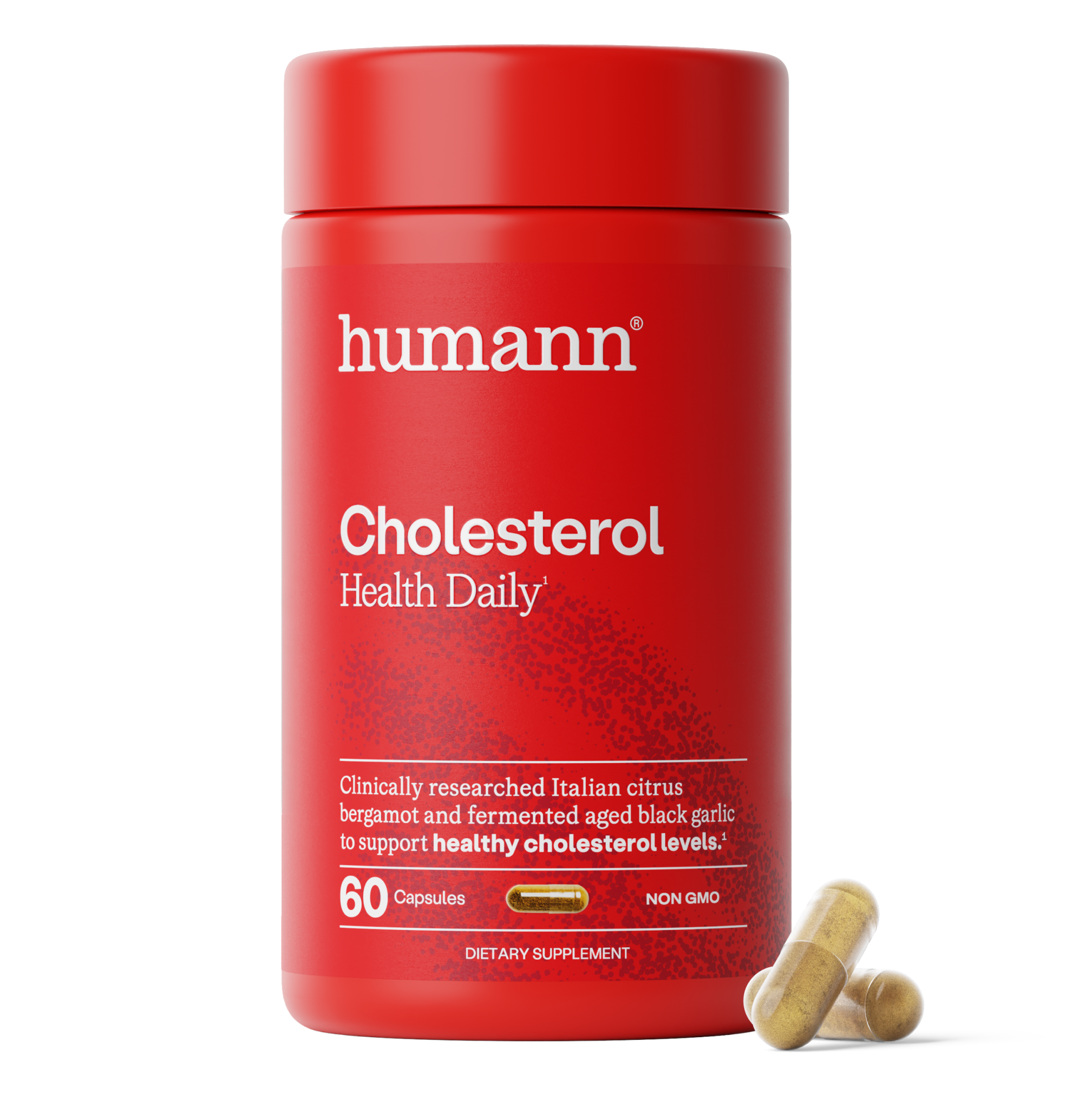
Understanding the full biology moves a cholesterol strategy from reactive to proactive. Diet and exercise remain the foundation. But for those who want a more targeted approach, research has identified certain plant-based compounds — such as aged black garlic extract and Italian citrus bergamot extract — with specific clinical evidence behind their role in supporting healthy cholesterol levels.
Aged black garlic extract, rich in S-Allylcysteine (SAC), has been studied in a double-blind, placebo-controlled trial and shown to support healthy HDL levels and healthy overall cholesterol.² Italian citrus bergamot extract — a patented polyphenol-rich extract from Calabria — has been backed by two published clinical studies for its role in supporting healthy cholesterol and lipid metabolism.³
¹Based on established physiology. Hartgers et al., Atherosclerosis, 2022. ²Nirvanashetty S. Journal of Complementary and Alternative Medicine. 2023;6(1). ³Toth PP, Patti AM, Nikolic D, et al. Frontiers in Pharmacology. 2016;6:299.